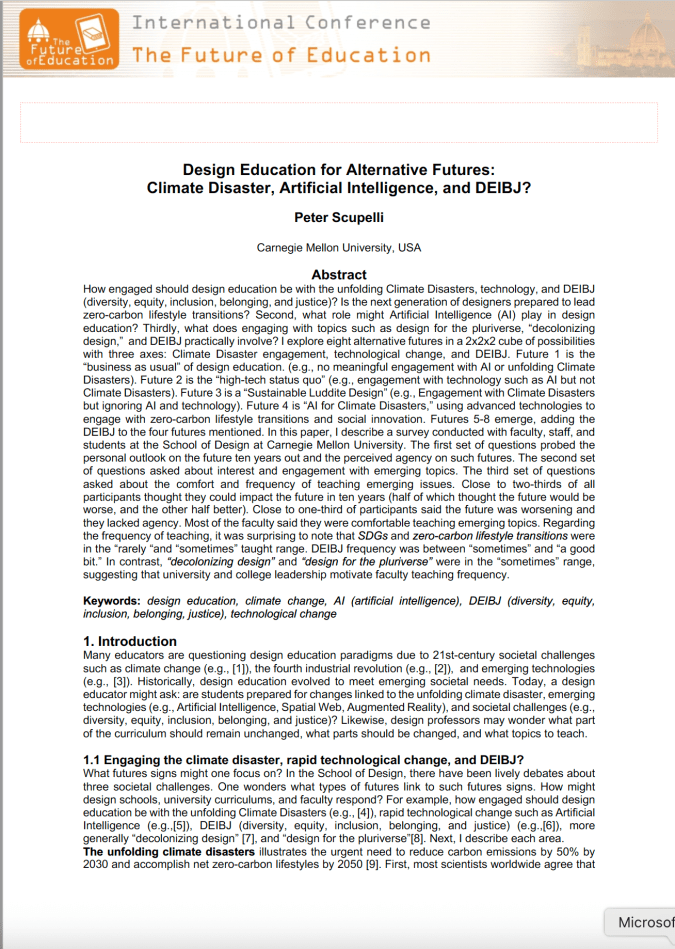
Invited Lecture @ Politecnico di Milano!

Gave an invited lecture on “Transitions Through Design” for the “Final Synthesis Design Studio” at the Politecnico di Milano, at the Scuola del Design, taught by Profs. Beatrice Villari, Daniela Sangiorgi, Davide Fassi, and Claudio Dell’Era.

I received wonderful questions from students and professors. Thank you for inviting me, and a big thank you to Dean Prof. Francesco Zurlo for the lovely certificate below!

It is incredibly heartwarming to know that transition design is being taught at leading institutions around the world.

Learn X Design 2025 conference paper September 22-24, 2025.

Peter Scupelli & Paulo Carvalho will present their co-authored paper titled “Design Futures Pedagogy: Does the type of exercise, year of study, order, and number of exercises matter?” at the DRS special interest group conference Learn X Design 2025 at the University of Aveiro, Portugal, on September 22-24.

Abstract

Teaching design for long-term, societal-level sustainability requires design students to learn new design methods that combine Futures Thinking with Design Thinking. This paper explores three questions: (a) how to teach Futures Thinking methods; (b) when to incorporate Futures Thinking into the undergraduate curriculum; and (c) how many exercises to assign to teach a futures method. In this paper, we focus on the Futures Thinking method called Causal Layered Analysis (CLA). Previous research has shown that a “Studio Project CLA” exercise is three times more effective than a “Personal Futures CLA” in helping students apply CLA to their design work. In this paper, undergraduate students in their first and third years did both exercises. We report on three studies. In Study 1, we replicated prior research using a larger dataset. Our results confirm that when performing a single exercise, the “Studio Project CLA” exercise is significantly more effective than the “Personal Futures CLA” exercise. In Study 2, we compared the performance of first-year and third-year design students on both exercises. We found that first-year students had more design insights on how they might apply CLA to design processes. In study 3, regarding the order and quantity of exercises, contrary to the maxim “more practice is better,” we found that “what one practices matters.” In other words, for first-year students, a single “Studio Project CLA” exercise provides more benefit than an additional “Personal Futures CLA” exercise. We posit that the observed transfer from “Futures Thinking” to “Design Thinking” may be explained by three theories from Learning Science literature: (a) concreteness and abstraction of the CLA exercises, (b) the layered aspects of CLA helped to emphasize structural similarities across contexts, (c) concreteness fading in the Design Studio exercise. This study examined the number of design insights; our future work will explore the types and quality of design insights.

Reference

Scupelli, P. & Carvalho, P. (2025) Design Futures Pedagogy: Does the type of exercise, year of study, order, and number of exercises matter?, DRS – Learn X Design intertwinia in Design Education conference in Aveiro, Portugal, on September 22-24, 2025.

Future of Education Conference Paper June 19-21, 2024.

April 25, 2024 3:17 PM

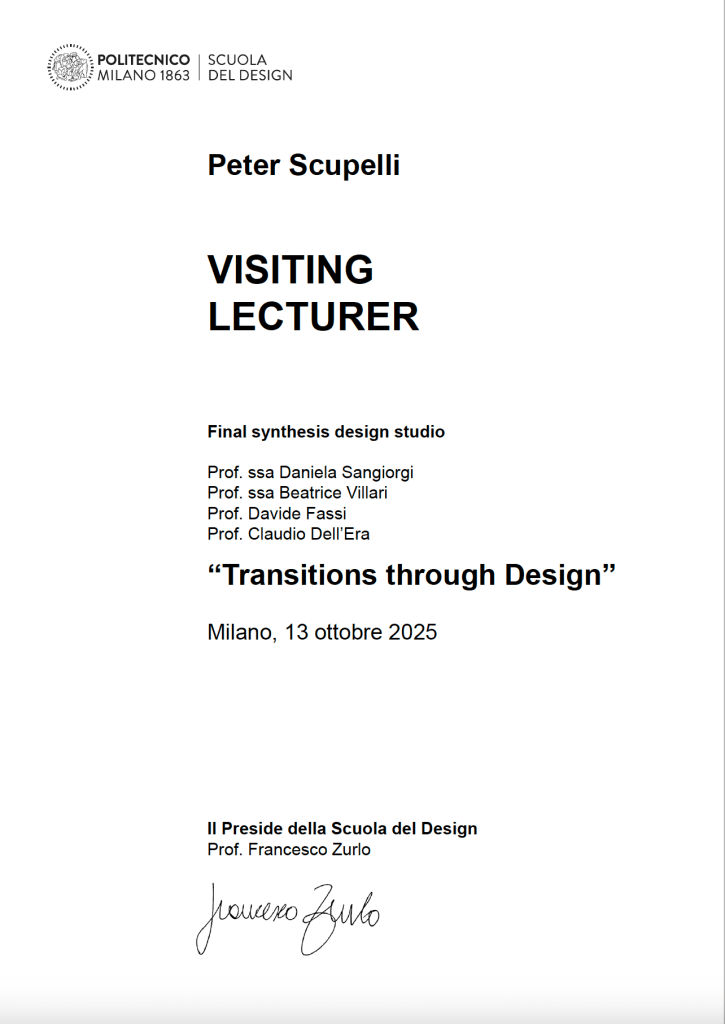
Peter Scupelli is presenting a paper titled “Design Education Alternative Futures: Climate Disaster, Artificial Intelligence, and DEIBJ?” at the 14th Future of Education International Conference in Florence, Italy on June 19-21.

Abstract

How engaged should design education be with the unfolding Climate Disaster, Artificial Intelligence, and DEIBJ (diversity, equity, inclusion, belonging, and justice)? Is the next generation of designers prepared to lead the zero-carbon transition? Second, what role might Artificial Intelligence (AI) play in design education? Thirdly, what does engaging with topics such as design for the pluriverse, decolonizing design, and DEIBJ practically involve? I explore a 2x2x2 cube of possibilities with three axes: Climate Disaster engagement, technological change, and DEIBJ—eight alternative futures result. Future 1 is the “business as usual” design education. (e.g., no meaningful engagement with AI or Climate disasters). Future 2 is the “high-tech status quo” (e.g., engagement with technology such as AI but not Climate Disaster). Future 3 is “Sustainable Luddite” design (e.g., Engagement with Climate Disaster but ignoring AI and technology). Future 4 is “AI for Climate Emergency,” using advanced technologies to engage with the zero-carbon transition and social innovation. Futures 5-8 emerge, adding the DEIBJ to the four futures mentioned. In this paper, I describe a survey conducted with faculty, staff, and students at the School of Design at Carnegie Mellon University. The first set of questions probed the personal outlook on the future ten years out and the perceived agency on such futures. The second set of questions asked about interest and engagement with emerging topics. The third set of questions asked about the comfort and frequency of teaching emerging issues. Close to two-thirds of all participants thought they could impact the future in ten years (half of which thought the future would be worse, and the other half better). Close to one-third of participants said the future was worsening and that they could not improve things. Most of the faculty said they were comfortable teaching emerging topics. Regarding frequency of teaching, it was surprising to note, that SDGs and zero-carbon lifestyle transitions were in the “rarely “and “sometimes” taught range. DEIBJ frequency was between “sometimes” and “a good bit.” In contrast, decolonizing design and design for the pluriverse were in the “sometimes” range, suggesting that university and college leadership motivate faculty teaching frequency.

Guest lecture “AI & SUSTAINABILITY: some dexign thinking for alternative futures”

March 8, 2024 11:03 PM

Peter Scupelli gave an invited lecture at the Politecnico di Milano, titled “AI & SUSTAINABILITY: some dexign thinking for alternative futures,” for the Service Design and Innovation – Smart Service course taught by Prof. Marzia Mortati in the Master’s Program in Product-Service Systems Design, at the Politecnico di Milano, on March, 8, 2024.

Invited lecture for the Connections Lecture Series

November 10, 2023 9:48 AM

Peter Scupelli is giving a lecture titled “Dexign Thinking: Finding Design Opportunities in Societal Transitions” at the Connections Lecture Series in Doha, Qatar on November 14, 2023 Time: 4:00 to 5:15 pm (Arabian Standard Time) in Room: 3048 at CMU-Q.

Abstract

Change is exponential. Products and services are developed faster, hold a shorter shelf-life disrupted by new offerings, and exist within global challenges such as climate change and sustainability. We live in the Anthropocene Era with the ongoing human-induced climate disaster and the sixth mass extinction. Design challenges for product/service creation are shifting from a customer-centric linear system to a new paradigm that includes a broader planetary context with a circular economy. The Human-Centered Design Thinking process popularized by IDEO/Stanford d.school identifies human-centered design opportunities for products and services through five steps: empathize, define, ideate, prototype, and test. Unfortunately, a mere customer-centric view for products and services is insufficient for planetary-scale challenges requiring a broader focus that includes all life forms and the planet’s health. Thus, moving forward, design for the 21st century requires broader perspectives; design educators are challenged to overcome the limitations of Human-Centered Design Thinking. The point of this lecture is that Human-Centered Design Thinking needs to be used in conjunction with futures thinking to yield new design methods that consider the larger planetary context over time. I discuss how futures thinking methods can augment design thinking methods to overcome limiting human-centered worldviews, epistemologies, and ontologies. In particular, how Causal Layered Analysis (CLA) can augment designers’ creative responses to behavior change challenges such as rapid decarbonization through four layers (e.g., litany, systems, worldview, myths/metaphors). CLA is a future studies method developed by Futurist Sohail Inayatullah. In this case study, I describe the challenges and insights from teaching design students to apply CLA to design future opportunities.

Global Design Futures Network Symposium and Workshops in Bali, Indonesia

November 10, 2023 10:29 AM

The 2023 Global Design Futures Network Symposium and Workshops are being held at the Tsinghua Southeast Asia Center in Bali, Indonesia November 16-19, 2023.

Global Design Futures Network (GDFN) was established through a memorandum of understanding signed in May 2023 by the Academy of Arts & Design at Tsinghua University, the Department of Design at Politecnico di Milano, and the School of Design at Carnegie Mellon University. The aim is to establish a global design futures learning platform and community, attracting global government, universities, institutions, scholars, and students to jointly promote the emergent practices mixing design and futures studies, and provide frontier methods and tools to address global challenges.

GDFN will gather academic resources and practical design futures cases from a global network and sustainably promote collaborative learning, teaching, and research. In addition, by organizing the establishment of academic exchange platforms and corporate cooperation platforms, we co-design future visions for global issues such as the United Nations Sustainable Development Goals, the challenges of the Anthropocene, climate adaptability, a community with a shared future for humankind, and future well-being.

There are five workshops:

  • Artificial Intelligence and Future Fashion facilitated by: Clarice Garcia,RMIT University Australia; WEI Qinwen, Beijing Institute of Fashion Technology; SONG Yi, Beijing Institute of Fashion Technology; Hosted by Ting Chawchen, Beijing Institute of Fashion Technology.
  • Artificial Intelligence and Future Cultural Tourism facilitated by: GAO Xiang, VOYA LINK ; Host: HE Siqian, University of Science and Technology Beijing; MA Yuemei, Politecnico di Milano, GDFN International Coordinator.
  • Futures Thinking and Consensus Community facilitated by Cheryl Chung, Kantar Public, Head of Singapore; Host: WANG Yun, Beihang University.
  • Strategic Foresight and Digital Futures facilitated by Jörn Buhring, Abu Dhabi University, Host: ZHU Lin, Tsinghua University, GDFN International Coordinator.
  • Artificial Intelligence Content Generation (AICG) and Future Metaverses facilitated by 分享嘉, 宾林宾华, 刘文俊 Host: ZHANG Mengting, Macau University of Science and Technology

GDFN co-founders Prof. Peter Scupelli, Prof. Anna Barbara, and Prof. Zhiyong FU will facilitate a community symposium to discuss the GDFN’s emergent mission, vision, and roadmap for the next three years.

Organizers: Academy of Arts & Design, Tsinghua University
Design Department, Politecnico di Milano 
School of Design, Carnegie Mellon University
HOST: Department of Information Art & Design, Academy of Arts & Design at Tsinghua University
CO-HOST: Tsinghua Southeast Asia Center
IASDR 2023

September 1, 2023 1:42 PM

Peter Scupelli will present a paper titled “Teaching to transfer Causal Layered Analysis from Futures Thinking to Design Thinking” at the 2023 IASDR conference held in Milan, Italy October 9-14 at The Politecnico di Milano.

Abstract
We live in exponentially changing worlds. Design educators are challenged to teach new design methods to productively engage with ongoing societal problems with planetary implications such as the Sustainable Development Goals, the unfolding climate disaster, zero-carbon lifestyles, circular economies, nuclear disarmament, etc. Such societal-level problems require both short-term design action and strategic long-term vision goal alignments. How might design educators teach new design methods effectively and efficiently within already packed design education curriculums? In this paper, I describe a required design futures course that teaches an experimental form of design, called Dexign Futures, it merges design thinking with futures thinking. One often unstated goal of teaching new design methods is to enable students to transfer such knowledge to other design courses, and, ultimately, to their professional practice. The futures thinking method, Causal Layered Analysis (CLA) is the focus of this paper. Prior research on Dexign Futures, made clear that with a “Personal Futures CLA” assignment, only 19.8% of design students could articulate how the Futures Thinking method CLA related to future design methods and practice. In this paper, I describe a new way to teach CLA called “Studio Project CLA”; it more than tripled the number of undergraduate design students (62%) who described applications of CLA to their design practice. I posit that transfer of knowledge mechanisms likely explain observed performance gains. I hypothesize key insights relevant for design educators to create design exercises for undergraduate design students that likely facilitate knowledge transfer from futures thinking methods into design practice.

Keynote at the “REFLECTING on the Metaverse through Experiential Futures”

February 2, 2023 3:03 PM

Peter Scupelli gave the closing keynote lecture titled “Some experiential dexign thinking for alternative metaverses” at the “REFLECTING on the Metaverse through Experiential Futures,” as part of the Design Thinking JAM, Sixth Edition of the Observatory of Design Thinking for Business, Rethinking Design Thinking, School of Management, Politecnico di Milano. Hosted at the NHOW Milano (Via Tortona, 35 – 20144 Milano), January 26, 2023.