Invited Lecture @ Politecnico di Milano!

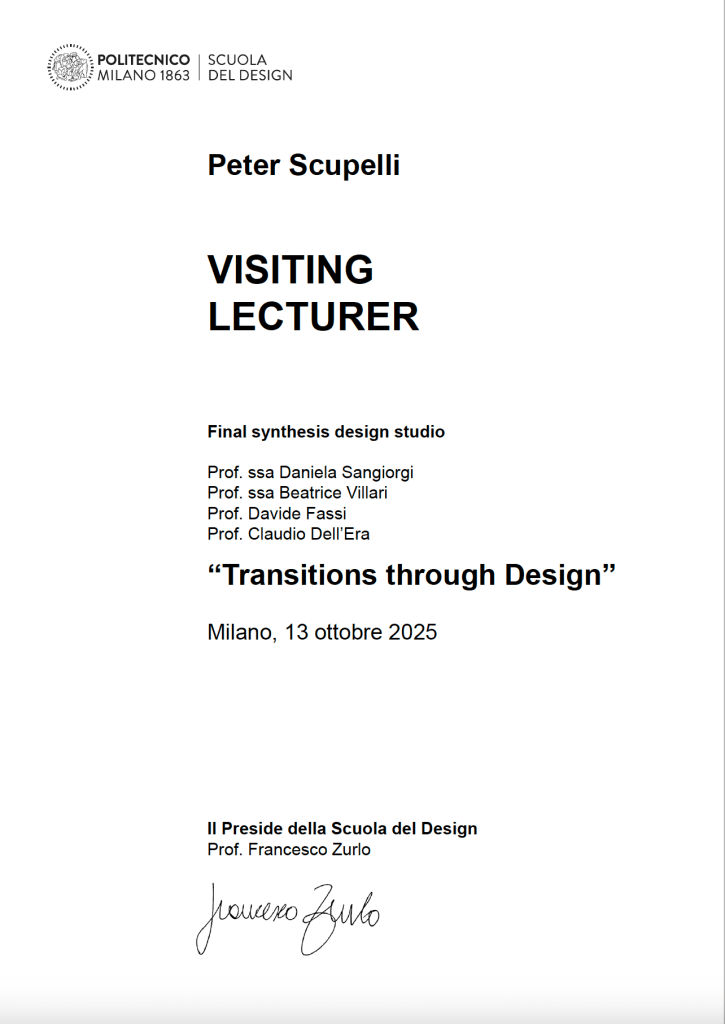
Gave an invited lecture on “Transitions Through Design” for the “Final Synthesis Design Studio” at the Politecnico di Milano, at the Scuola del Design, taught by Profs. Beatrice Villari, Daniela Sangiorgi, Davide Fassi, and Claudio Dell’Era.

I received wonderful questions from students and professors. Thank you for inviting me, and a big thank you to Dean Prof. Francesco Zurlo for the lovely certificate below!

It is incredibly heartwarming to know that transition design is being taught at leading institutions around the world.

Guest lecture “AI & SUSTAINABILITY: some dexign thinking for alternative futures”

March 8, 2024 11:03 PM

Peter Scupelli gave an invited lecture at the Politecnico di Milano, titled “AI & SUSTAINABILITY: some dexign thinking for alternative futures,” for the Service Design and Innovation – Smart Service course taught by Prof. Marzia Mortati in the Master’s Program in Product-Service Systems Design, at the Politecnico di Milano, on March, 8, 2024.

Invited lecture for the Connections Lecture Series

November 10, 2023 9:48 AM

Peter Scupelli is giving a lecture titled “Dexign Thinking: Finding Design Opportunities in Societal Transitions” at the Connections Lecture Series in Doha, Qatar on November 14, 2023 Time: 4:00 to 5:15 pm (Arabian Standard Time) in Room: 3048 at CMU-Q.

Abstract

Change is exponential. Products and services are developed faster, hold a shorter shelf-life disrupted by new offerings, and exist within global challenges such as climate change and sustainability. We live in the Anthropocene Era with the ongoing human-induced climate disaster and the sixth mass extinction. Design challenges for product/service creation are shifting from a customer-centric linear system to a new paradigm that includes a broader planetary context with a circular economy. The Human-Centered Design Thinking process popularized by IDEO/Stanford d.school identifies human-centered design opportunities for products and services through five steps: empathize, define, ideate, prototype, and test. Unfortunately, a mere customer-centric view for products and services is insufficient for planetary-scale challenges requiring a broader focus that includes all life forms and the planet’s health. Thus, moving forward, design for the 21st century requires broader perspectives; design educators are challenged to overcome the limitations of Human-Centered Design Thinking. The point of this lecture is that Human-Centered Design Thinking needs to be used in conjunction with futures thinking to yield new design methods that consider the larger planetary context over time. I discuss how futures thinking methods can augment design thinking methods to overcome limiting human-centered worldviews, epistemologies, and ontologies. In particular, how Causal Layered Analysis (CLA) can augment designers’ creative responses to behavior change challenges such as rapid decarbonization through four layers (e.g., litany, systems, worldview, myths/metaphors). CLA is a future studies method developed by Futurist Sohail Inayatullah. In this case study, I describe the challenges and insights from teaching design students to apply CLA to design future opportunities.

Global Design Futures Network Symposium and Workshops in Bali, Indonesia

November 10, 2023 10:29 AM

The 2023 Global Design Futures Network Symposium and Workshops are being held at the Tsinghua Southeast Asia Center in Bali, Indonesia November 16-19, 2023.

Global Design Futures Network (GDFN) was established through a memorandum of understanding signed in May 2023 by the Academy of Arts & Design at Tsinghua University, the Department of Design at Politecnico di Milano, and the School of Design at Carnegie Mellon University. The aim is to establish a global design futures learning platform and community, attracting global government, universities, institutions, scholars, and students to jointly promote the emergent practices mixing design and futures studies, and provide frontier methods and tools to address global challenges.

GDFN will gather academic resources and practical design futures cases from a global network and sustainably promote collaborative learning, teaching, and research. In addition, by organizing the establishment of academic exchange platforms and corporate cooperation platforms, we co-design future visions for global issues such as the United Nations Sustainable Development Goals, the challenges of the Anthropocene, climate adaptability, a community with a shared future for humankind, and future well-being.

There are five workshops:

  • Artificial Intelligence and Future Fashion facilitated by: Clarice Garcia,RMIT University Australia; WEI Qinwen, Beijing Institute of Fashion Technology; SONG Yi, Beijing Institute of Fashion Technology; Hosted by Ting Chawchen, Beijing Institute of Fashion Technology.
  • Artificial Intelligence and Future Cultural Tourism facilitated by: GAO Xiang, VOYA LINK ; Host: HE Siqian, University of Science and Technology Beijing; MA Yuemei, Politecnico di Milano, GDFN International Coordinator.
  • Futures Thinking and Consensus Community facilitated by Cheryl Chung, Kantar Public, Head of Singapore; Host: WANG Yun, Beihang University.
  • Strategic Foresight and Digital Futures facilitated by Jörn Buhring, Abu Dhabi University, Host: ZHU Lin, Tsinghua University, GDFN International Coordinator.
  • Artificial Intelligence Content Generation (AICG) and Future Metaverses facilitated by 分享嘉, 宾林宾华, 刘文俊 Host: ZHANG Mengting, Macau University of Science and Technology

GDFN co-founders Prof. Peter Scupelli, Prof. Anna Barbara, and Prof. Zhiyong FU will facilitate a community symposium to discuss the GDFN’s emergent mission, vision, and roadmap for the next three years.

Organizers: Academy of Arts & Design, Tsinghua University
Design Department, Politecnico di Milano 
School of Design, Carnegie Mellon University
HOST: Department of Information Art & Design, Academy of Arts & Design at Tsinghua University
CO-HOST: Tsinghua Southeast Asia Center
Keynote at the “REFLECTING on the Metaverse through Experiential Futures”

February 2, 2023 3:03 PM

Peter Scupelli gave the closing keynote lecture titled “Some experiential dexign thinking for alternative metaverses” at the “REFLECTING on the Metaverse through Experiential Futures,” as part of the Design Thinking JAM, Sixth Edition of the Observatory of Design Thinking for Business, Rethinking Design Thinking, School of Management, Politecnico di Milano. Hosted at the NHOW Milano (Via Tortona, 35 – 20144 Milano), January 26, 2023.

Future of Education Charrette

July 20, 2017 5:44 PM

Futures of Education Charrette

Peter Scupelli is joining two dozen leading thinkers, tech visionaries, librarians and change-agents to help imagine a new universe of collaborative systems that could transform the academy.  The group convenes at Indiana University’s Ostrom Workshop, founded by commons scholar and Nobel laureate Professor Elinor Ostrom, from July 22 to 24, 2017, to explore new patterns of scholarly commons that could help invigorate open science, the humanities and academic institutions more generally.  The charrette is being hosted by Earth Science Information Partners and the Ostrom Workshop at Indiana University. The Alfred P. Sloan Foundation has provided funding for this endeavor.

It is an open secret that many structures and protocols of academic research, communication, and collaboration are relics of another era, unable to take full advantage of the rich affordances of digital networks. In addition, many academic systems are overly formal, hierarchical, and credential-driven. While open platforms have significantly advanced scientific and academic missions, many fields of inquiry are discovering that open access and sharing are not enough.

What’s needed is active stewardship, curation, peer commitment and “commoning” – the social practices, ethical norms and processes by which a community can govern itself and manage its research objects. To explore the possibilities, we are convening a “pattern lexicon” charrette to identify possible “design patterns” based on the efforts of several open-science organizations committed to open access to scholarly resources.

There are already encouraging developments in this direction. Just last year, the European Commission announced support for a European scholarly commons as the future of EU science (Open Innovation). At the same time,Force11 is exploring how a scholarly commons can serve as the organizational schema for better governance and management of scientific data sets, software, work-flows, and publications.

Last updated: 2:51 pm

Presentation@2nd Annual Winter School Design Summit

January 25, 2017 3:26 PM

Peter Scupelli gave a keynote talk on “How might design educators teach to Transition Design?” at The Glasgow School of Art’s 2nd Annual Winter School Design Summit in Scotland.  The theme of this year’s summit was Innovation from Tradition, and explored the relationship between culture and economy, between design and its consumption, as a means of formulating alternative economic and social arrangements for living, exemplified by rural living and a non-industrialized economy.  The summit hoped to turn a network of known entities into a fledgling community, to shift pedagogies into share practices and to establish a platform for future exchanges.

Students and faculty from KADK Copenhagen and KISD Cologne, the PhD cohort of Konstfack Stockholm and Glasgow School of Art’s PGT (Postgraduate Taught) Masters in Design Innovation as well as their PGR (Postgraduate Research) students participated.

Abstract:

How might design educators transition their courses to educate the next generations of designers to transition design to achieve sustainable futures? Design educators are caught between competing challenges: first, teaching well-established design traditions based on craft and making; and second, training students to situate their artifact making within transitional times in a volatile and exponentially changing world. Design educators can navigate such tensions  by linking the core of their discipline in relation to an expanding periphery where multiple disciplines interact. Teaching to transition design introduces a interesting teaching and learning design challenges. While the first formal presentation of Transition Design by Terry Irwin, Cameron Tonkinwise, and Gideon Kossoff occurred in 2013, there were many conversations among faculty and students leading to up to it. In this paper, I describe five courses that I taught at the Carnegie Mellon University School of Design from 2011 to 2016. Through this case study, I describe how one newly hired faculty member began to integrate the new vision for the School of Design based on Transition Design in the courses I taught to undergraduates and graduate students. The new Undergraduate, Graduate and Doctoral curriculum were deployed in fall semester 2014. The intended audience for this paper is faculty and students that are nervous and excited about undergoing curricular changes.

Last updated: 3:26 pm

Futures Panel@2016 a2ru National Conference

August 16, 2016 10:45 AM

Peter Scupelli gave a talk on the opening plenary panel 2016 a2ru National Conference at the University of Colorado in Denver.  The theme of this year’s conference was ArtsRx: Creative Venture, Wellbeing & the New Humanities. The conference highlighted keynote speakers, panels, breakout sessions and workshops that explore and reflect arts-integrative interdisciplinary research and practice in higher education related to the following topics:

  • Arts and Health
  • Arts and Entrepreneurship
  • Science, Engineering, Arts & Design (S.E.A.D.)
  • New Directions and Applications in the Humanities

The opening plenary panel was a “Futures Panel” — using foresight as a cross-cutting lens to motivate a2ru’s work, to provide a bridge for adopting futures thinking into practice (as artists, scholars, interdisciplinarians), and to highlight it as a core skill for academic leadership.

The panel was composed of a collection of futures-based practitioners in the arts and was moderated by J.D. Talasek, Director of Cultural Program at the National Academy of Sciences, with student respondents from MIT, UT Dallas, and UC Denver.

Last updated: 10:45 am