Invited Lecture @ Politecnico di Milano!

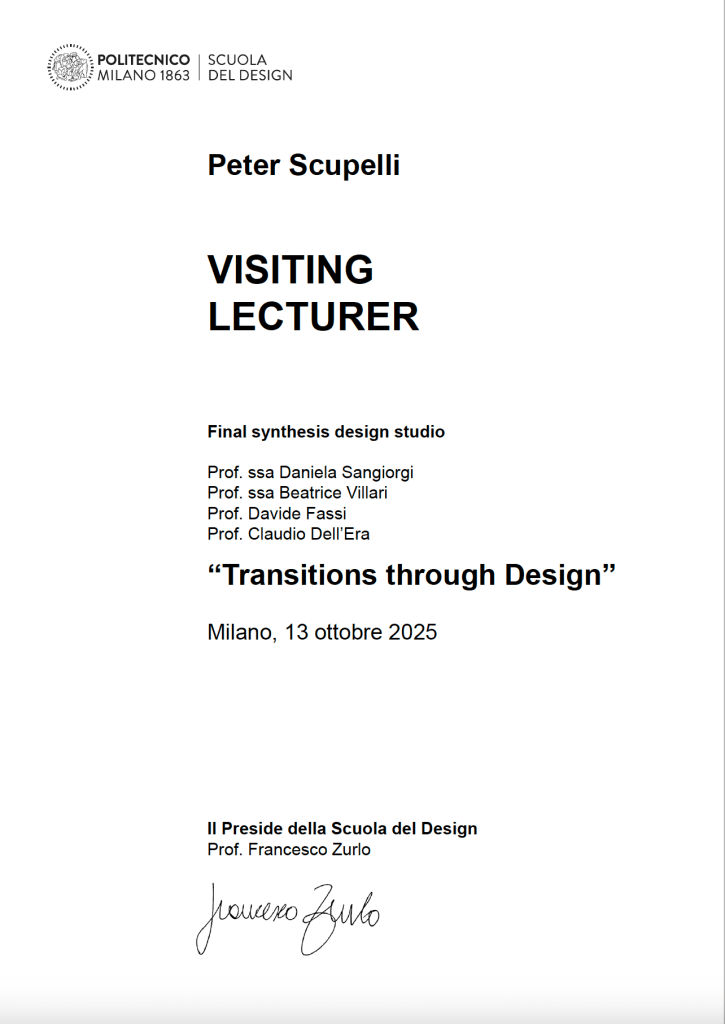
Gave an invited lecture on “Transitions Through Design” for the “Final Synthesis Design Studio” at the Politecnico di Milano, at the Scuola del Design, taught by Profs. Beatrice Villari, Daniela Sangiorgi, Davide Fassi, and Claudio Dell’Era.

I received wonderful questions from students and professors. Thank you for inviting me, and a big thank you to Dean Prof. Francesco Zurlo for the lovely certificate below!

It is incredibly heartwarming to know that transition design is being taught at leading institutions around the world.

Keynote at the “REFLECTING on the Metaverse through Experiential Futures”

February 2, 2023 3:03 PM

Peter Scupelli gave the closing keynote lecture titled “Some experiential dexign thinking for alternative metaverses” at the “REFLECTING on the Metaverse through Experiential Futures,” as part of the Design Thinking JAM, Sixth Edition of the Observatory of Design Thinking for Business, Rethinking Design Thinking, School of Management, Politecnico di Milano. Hosted at the NHOW Milano (Via Tortona, 35 – 20144 Milano), January 26, 2023.

China National Arts Fund Initiation and forum: Training innovative art and tech talents for the 2022 Winter Olympics Games.

June 1, 2018 5:54 PM

Peter Scupelli delivered a keynote speech titled “Olympic projects as desirable futures” at the “China National Arts Fund Initiation and forum: Training innovative art and tech talents for the 2022 Winter Olympics Games” on June 9 at the Academy of Arts and Design, Tsinghua University.

http://www.ieeac2015.org.cn/p/17/20180614/171813553838279.html

Last updated: 2:36 pm

US2020 STEM Collaboratory Keynote

January 24, 2018 3:52 PM

Kristin Hughes and Peter Scupelli are keynoting for the US2020 STEM Collaboratory workshop Thursday, February 1, 2018.

About the US2020 Challenge
The US2020 STEM Challenge is a competition for communities that are working together through cross-sector partnerships to bridge the opportunity gap and bring maker-centered learning and STEM mentorship opportunities to more girls, low-income students, and underrepresented students in their local communities.

Over 92 communities across the country applied to the competition, proposing innovative approaches for cross-sector collaboration and exciting STEM solutions in their communities. A panel of expert judges helped US2020 select fifteen finalist communities to move on to the final round of the competition. They’re currently in the process of engaging their stakeholders, refining their proposals, and will revise and resubmit their application prior to attending the STEM Collaboratory event. More information about the Challenge can be found on our website and in our press release.

The STEM Collaboratory
The celebration of their work will culminate at a STEM Collaboratory event, where communities will highlight what they’re doing in the collective impact space to bring engaging and enticing opportunities to students across the country through their cross-sector partnerships. This two-day workshop will expose communities to STEM and maker experts and creative community builders and provide an opportunity for communities to share share, learn, and inspire one another to build local movements around STEM mentorship and maker-centered learning and bridge the opportunity gap.

The objectives of the event overall are to:
●      Provide a space for teams to reflect, share, and refine their strategies for embedding maker-centered learning and STEM mentorship into their communities
●      Expose finalist teams to experts that can facilitate new learning, spark deep, rich conversation between teams, and share meaningful feedback
●      Strengthen relationships between Finalist Teams
●      Introduce helpful frameworks for working through barriers and challenges
●      Create a learning experience that is meaningful and applicable, regardless of Challenge outcome

Audience and their Work
This event will bring together 45 leaders representing 15 communities across the country. Each community will be represented at the event by 2-3 local leaders that are spearheading this work. These leaders will represent the non-profit, public, and private sectors, and are all working to strengthen their local STEM and maker-centered learning movements locally.

Each community has been working to build a collective action and impact model around STEM mentorship and maker-centered learning. All of these communities are focused on mobilizing stakeholders in their community to drive systemic change. Some of these communities also design and implement programs related to maker-centered or project-based learning. These communities are quite diverse – some are from larger cities like New York and Chicago, while others are working in more rural contexts, like Socorro, New Mexico or Allendale, South Carolina. Learn more about our finalists here.

Date + Venue

The event will take place from Wednesday, January 31- Thursday, February 1, 2018 at Alloy 26, located at 100 S Commons Suite 102, Pittsburgh, PA 15212

Last updated: 5:50 pm
Presentation@2nd Annual Winter School Design Summit

January 25, 2017 3:26 PM

Peter Scupelli gave a keynote talk on “How might design educators teach to Transition Design?” at The Glasgow School of Art’s 2nd Annual Winter School Design Summit in Scotland.  The theme of this year’s summit was Innovation from Tradition, and explored the relationship between culture and economy, between design and its consumption, as a means of formulating alternative economic and social arrangements for living, exemplified by rural living and a non-industrialized economy.  The summit hoped to turn a network of known entities into a fledgling community, to shift pedagogies into share practices and to establish a platform for future exchanges.

Students and faculty from KADK Copenhagen and KISD Cologne, the PhD cohort of Konstfack Stockholm and Glasgow School of Art’s PGT (Postgraduate Taught) Masters in Design Innovation as well as their PGR (Postgraduate Research) students participated.

Abstract:

How might design educators transition their courses to educate the next generations of designers to transition design to achieve sustainable futures? Design educators are caught between competing challenges: first, teaching well-established design traditions based on craft and making; and second, training students to situate their artifact making within transitional times in a volatile and exponentially changing world. Design educators can navigate such tensions  by linking the core of their discipline in relation to an expanding periphery where multiple disciplines interact. Teaching to transition design introduces a interesting teaching and learning design challenges. While the first formal presentation of Transition Design by Terry Irwin, Cameron Tonkinwise, and Gideon Kossoff occurred in 2013, there were many conversations among faculty and students leading to up to it. In this paper, I describe five courses that I taught at the Carnegie Mellon University School of Design from 2011 to 2016. Through this case study, I describe how one newly hired faculty member began to integrate the new vision for the School of Design based on Transition Design in the courses I taught to undergraduates and graduate students. The new Undergraduate, Graduate and Doctoral curriculum were deployed in fall semester 2014. The intended audience for this paper is faculty and students that are nervous and excited about undergoing curricular changes.

Last updated: 3:26 pm